A research update from the BUas Experience Lab
Measuring memorable experiences

Over the past few years, the Experience Lab has evolved into a truly BUas-wide platform for BUas R&D staff, and projects have been initiated and completed in all of BUas’ knowledge domains: leisure, tourism, hospitality, hotel and facility, mobility, games and media. The basis for all of the measurement tools used at the Experience Lab (neuroscience tools and more traditional quantitative and qualitative research tools) is formed by the notion that emotions are crucial in shaping memorable experiences. Therefore, in order to objectively measure whether an experience is memorable, researchers in the Experience Lab track emotions in (real) time as people are engaging in leisure, tourism, mobility, hospitality, media or game experiences. The outcomes of those measurements provide a wealth of information for industry partners, academics, and in-house, BUas-based experience designers, about when exactly in time emotions are experienced, and about how to create new experiences, or about how to modify or improve existing experience designs so as to create more impact on visitors. Here we give a brief description of a few research projects that have involved researchers from these different domains. As you will see, these research projects feature recent technological developments in both the design and the measurement of experiences. We anticipate that those developments will dictate part of the knowledge development agenda for the BUas Experience Lab in the years to come.
Prof. dr Marcel Bastiaansen is a full professor of Leisure and Tourism, and director of the BUas Experience Lab. Dr Wim Strijbosch is a senior researcher at the Experience Lab.
TheARter: experiencing augmented reality in staged entertainment
One such project nicely exemplifies how starting up a collaboration across different knowledge domains leads to innovation for the leisure industry. In this project, funded by click.nl, the Academy for Leisure & Events collaborated with the Academy for Games & Media on establishing whether Augmented Reality can be effectively used as an experience design tool to improve the experience of a contemporary dance performance. External partners for this project were Dutch Rose Media, specialising in developing AR/VR applications, pop music venue The Effenaar in Eindhoven, and two professional dancers who developed a ten-minute contemporary dance specifically for this project.
The narrative that was contained in the dance performance was analysed by the dancers, by a team of AR developers from BUas and Dutch Rose Media, and by researchers from the Experience Lab. Subsequently, AR content was developed such that it would support the narrative contained in the dance performance. The AR content consisted of projected, 3D computer-generated graphics that were overlaid onto the ‘real world’ when viewing through specially designed, head-mounted devices that look very much like glasses.
The AR content distracted the audience from the actual performance.
A group of approximately 60 participants then attended the dance performance at the Effenaar, of which 30 experienced the AR-enhanced performance (wearing AR glasses), and 30 attended the dance performance without AR enrichment. Another group of approximately 60 participants attended a TV broadcast of the dance performance in a home-like setting, again either with or without AR enrichment. Note that the at-home viewing took place in small groups of maximally six participants, so as to mimic a home-like setting as much as possible.
Researchers from the Experience Lab then measured how each of the four groups (Effenaar, Effenaar + AR, home, home + AR) experienced the dance performance, by recording skin conductance while the participants were watching the performance (the objective measurement), and by asking the participants after the show to reconstruct how they experienced the performance (the subjective measurement). Both types of measurement indicated that adding AR substantially improved the experience in an at-home setting. However, in the staged entertainment setting at the Effenaar, adding the AR resulted in a less positive experience. This effect probably occurred because the AR content distracted the audience from the actual performance.
The lessons that one can take home from this study is that AR has the potential to improve experiences, especially in at-home settings, as they make these experiences more immersive. In staged entertainment settings however, the experience designers should take great care to align the AR contents with the actual performance, so as to not draw the audience’s attention away from the actual performance, but to create synergy with that performance. At the Experience Lab we are keen on continuing this strand of research projects, as we see great potential in the developments with AR technology. A new project has already started meanwhile.
Emotional heatmaps highlight the sections of a theme park where visitors experience the highest sense of emotional engagement.
How does our brain perceive tourism crowding?
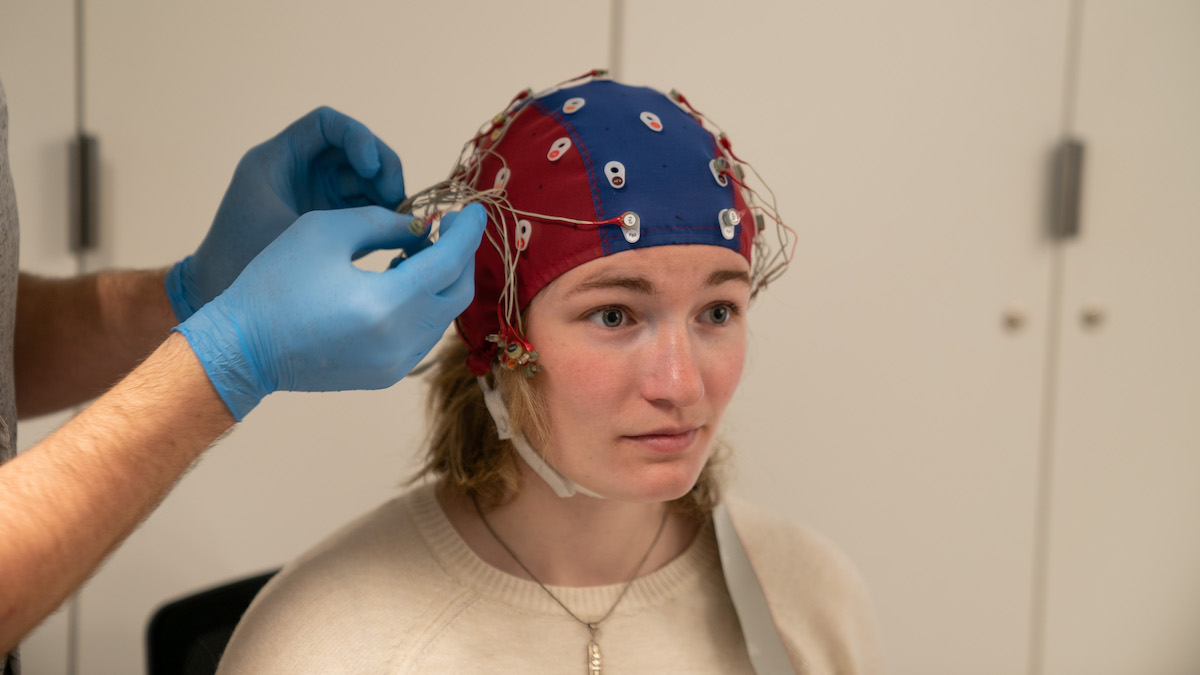
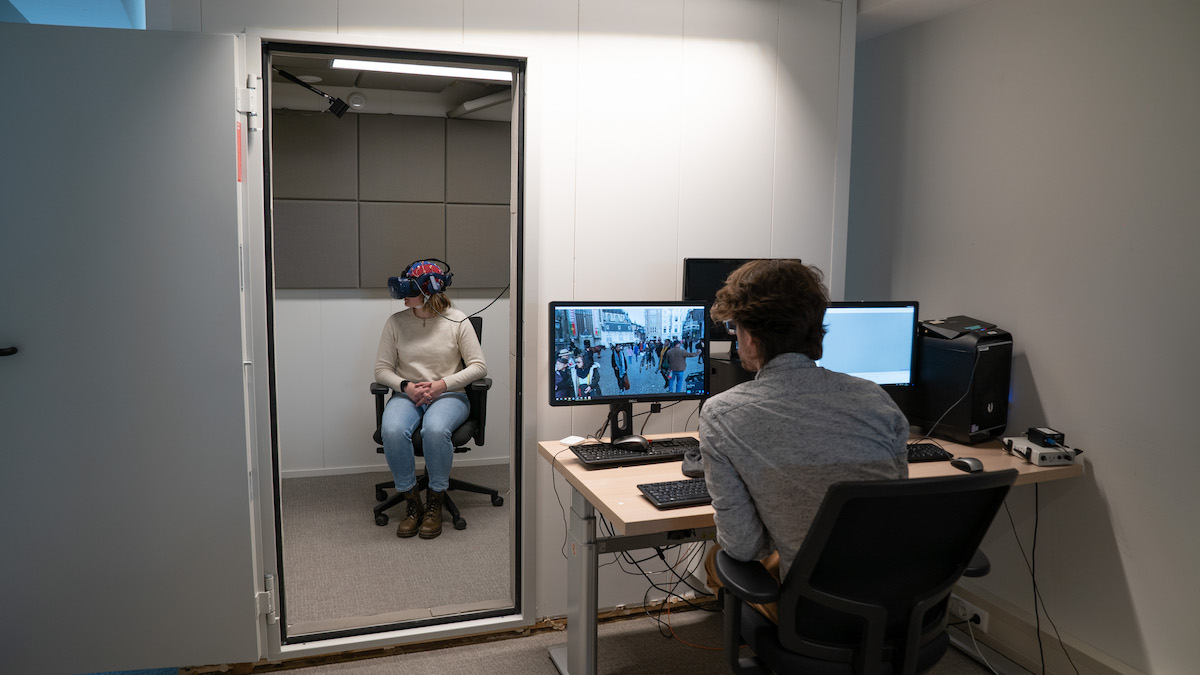
Another example of how technologies from the Experience Lab can be applied to the various domains of leisure is a recent study on crowding perception in tourism, as part of the ‘Data & Development Lab Destinatie Nederland’ (DDL) programme supported by NBTC (Netherlands Board of Tourism and Conventions), CBS (Statistics Netherlands) and CELTH (Centre of Expertise in Leisure, Tourism and Hospitality). Using virtual reality equipment, we generated various 360-degree pictures of different crowding levels at tourism hotspots throughout the city of Amsterdam – a city greatly suffering from overtourism. A total of 45 participants from two different target groups (backpackers and parents from families with children) were invited to the BUas Experience Lab and were presented with the 360-degree pictures through an HTC Vive Pro virtual reality device, while their electrical brain activity was being measured using EEG technology. For each of the various 360-degree pictures, participants were asked to indicate their experience level of emotional valence, i.e., the extent to which they felt emotionally negative or positive on a scale from one to five. Questionnaire results seemed to show that there is an optimal level of crowding: empty places were rated more negatively than lightly crowded places, but after this point participants’ feelings of negativity went up as the pictures became more crowded again. More interestingly, results of the EEG analyses demonstrated that more brain activity was observed over the motor cortex as crowding and crowding density levels on the 360-degree pictures increased. As more activity in the brain’s motor cortex is associated with action readiness, these brain responses might indicate that as places get more crowded, tourists might feel the urge to ‘get out of here’. These findings show that crowding perception can be measured both consciously and unconsciously, with both methods bringing different aspects of crowding perception to the fore. Findings are currently being published in the scientific literature.
The brain responses indicate that as places get more crowded, tourists feel the urge to ‘get out of here’.
Experiencing attractions in theme parks
Finally, the Experience Lab has been conducting several studies in the theme park industry in close cooperation with both theme parks themselves as well as ride manufacturers. Previously, our lab had already published a study on comparing a standard roller coaster ride against a ride with a virtual reality add-on in Europa-Park (see Bastiaansen et al., 2022). Findings showed that a virtual reality add-on can yield an emotionally more intense roller coaster experience compared to the standard roller coaster experience. These findings demonstrated the experiential impact of such investments in already existing roller coasters. Currently, the Experience Lab is taking its research programme on roller coaster experiences to new heights in close cooperation with Vekoma Rides Manufacturing by measuring roller coaster attendees’ emotions on F.L.Y. – a record-breaking flying launch coaster at Phantasialand. Results are currently being processed and will be shared soon with our industry partners. Also, the Experience Lab has been doing research at various other types of rides and attractions, such as dark rides and musical theatre shows (see e.g. Strijbosch et al., 2021). Additionally, in close cooperation with various theme parks throughout Europe, the Experience Lab is working on developing emotional heatmaps, which highlight the sections of a theme park where visitors experience the highest sense of emotional engagement. Knowing what visitors feel at which moments and which places in the park provides unprecedented tools for theme park managers to optimise their visitor experience in ways that go beyond the implications of traditional survey methods and visitor questionnaires.
Sources
- Bastiaansen, M., Oosterholt, M., Mitas, O., Han, D. & Lub, X. (2022). An emotional roller coaster: Electrophysiological evidence of emotional engagement during a roller-coaster ride with virtual reality add-on. Journal of Tourism & Hospitality Management 46(1), pp. 29-54.
- Strijbosch, W., Mitas, O., Van Blaricum, T., Vugts, O., Govers, C., Hover, M., Gelissen, J. & Bastiaansen, M. (2021). Evaluating the temporal dynamics of a structured experience: Real-time skin conductance and experience reconstruction measures. Leisure Sciences. pp.1-25.