The role of leisure in transitioning towards inclusive cities
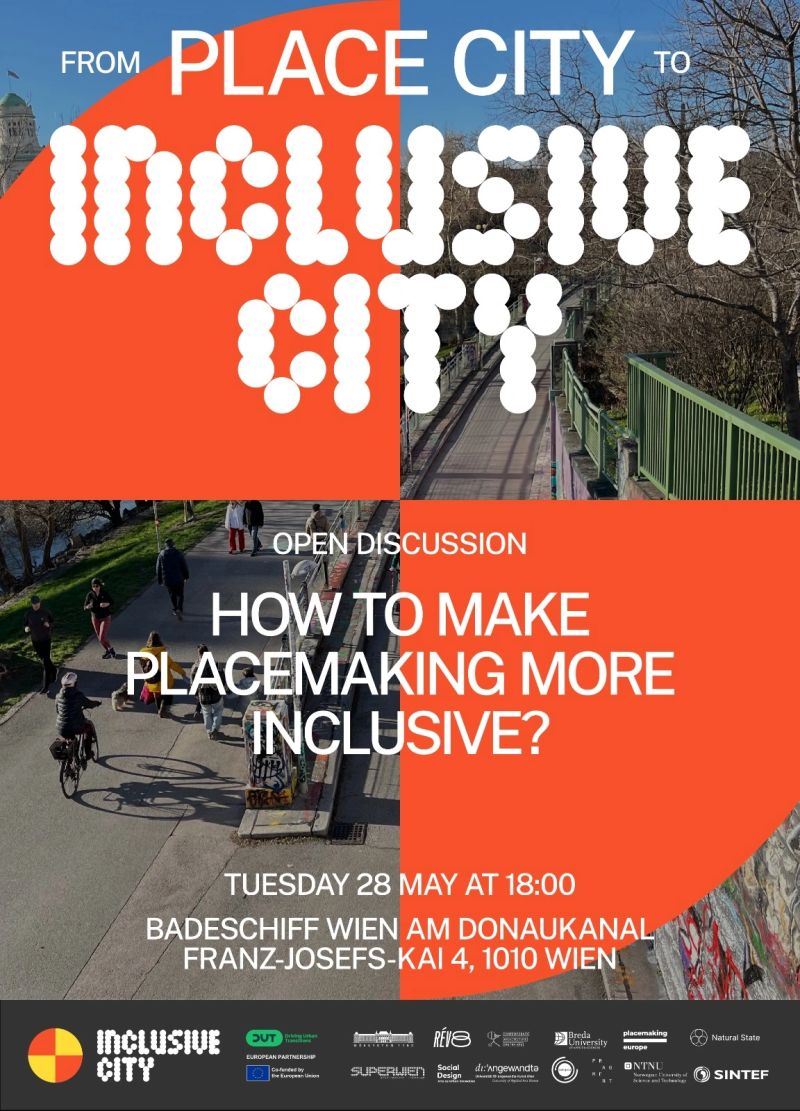
The InclusiveCity project

As of January 2024, two academies of Breda University of Applied Sciences (BUas), namely Academy for Leisure & Events and Academy of Built Environment & Logistics, together with Placemaking Europe, Superwien, KÉK, the Norwegian University of Science and Technology, amongst others, are partners of the international research project, InclusiveCity, which as the name suggests focuses on inclusive urban development. This was made possible thanks to an intergovernmental research and innovation?programme, called Driving Urban Transitions (DUT), which stimulates partnerships to address key challenges of European Cities in urban transitions towards sustainability while bettering the quality of lives of their citizens.?
Dr Marisa de Brito’s (interventive and academic) research at BUas focuses on impacting the quality of places and their communities through sustainable development.?
Andrew Shaw is part of the Urban Life & Placemaking specialisation at BUas and has a focus on the role of inclusive sustainable leisure in urban development.?
The 15-minute city concept?
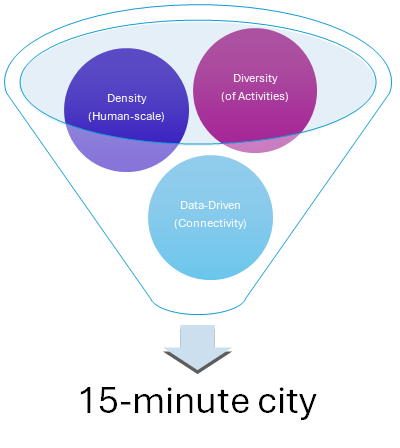
InclusiveCity builds upon placemaking concepts such as the 15-minute city, a concept popularised by Carlos Moreno, where there is an adequate density of a variety of city functions, such as education, work, healthcare, and leisure, just a small walk or ride away, by public transportation or bike. The premise is that such city design will nurture a healthy and pleasant way of living, furthering the quality of life for its inhabitants. Originally, the concept had roughly three founding principles Density, Diversity, and Data-Driven (see Figure 1). ?
The 15-minute city concept has been criticised for taking a one-size-fits-all approach.
However, the 15-minute city concept has been criticised for taking a one-size-fits-all approach, potentially leading to the exclusion of certain social groups, disregarding local cultural or natural heritage (Khavarian-Garmsir et al., 2023) or restricting freedom. In 2023 Oxford faced protests against the local council’s 2040 vision of the city, with people fearing surveillance and 15-minute ghettos, alluding to the less pleasant experience of the Covid-19 pandemic and the then imposed mobility restrictions. The protest was more about the potential lack of civil liberty than the essence of the 15-minute concept inspired by the notion of locality, where services are produced locally and for the benefit of locals. No one opposes the benefits, however, if services are unequally distributed between different areas of the city, they may become areas of privileged and underprivileged residents, exacerbating inequality and city bubbles.
Leisure accelerates sustainable development
The integration of active leisure areas in urban environments, and its adequate design, is a great means to promote an inclusive user of space, e.g. across genders, ages, and social groups (Janpavle and ?le, 2022). Sports and other leisure activities can power inclusion by bonding people during their relaxation time. Once such social bonds are crafted, they do contribute not to individual well-being, but to the well-being of communities and safer neighbourhoods. Think, for instance, of children playing together, while adults picnic in the local park.
Leisure areas can play a paramount role in fostering inclusion in urban areas, and therefore in accelerating sustainable development. This said, leisure areas can also do the opposite and lead to social exclusion. Therefore, a proper design of leisure areas is key in making the 15-minute city more inclusive. This aligns with the United Nations Sustainable Development Goals, and in particular SDG #11, which focuses on sustainable cities and their communities.
InclusiveCity: Project and Objectives?
The project sets out to develop a toolbox, which could be used by policy-makers to engender inclusion in area development, especially in terms of access to leisure facilities, and to actively address potential exclusion in the design or organisation of space. There is a particular focus on mobility within the context of the 15-minute city: ensuring access to waterfronts and de-commodification of public spaces.
The toolbox will be developed concurrently with an international consortium in five European cities: Budapest, Oslo, Rome, Rotterdam and Vienna. The structure will vary slightly from city to city, with pilots utilising the Urban Living Lab method, established with the involvement of local stakeholders, communities, and specific target groups. In Vienna, there will be a focus on reclaiming the Donaukanal waterfront to improve quality of life. In Budapest, the feeling of safety and healthy streets are the themes. Oslo will focus on intergenerational public space through tactical placemaking interventions and Rome will build community centres and foster social inclusion.
The testing phase of the labs will be directed by local challenges and reflect the needs of the local communities. The findings of these experiments and interventions will be shared amongst the consortium, with further developments of these methods in different cities leading to insights into how the tools and methods work (or not) in different situations.??
The case of Rijnhaven, Rotterdam?
The BUas team decided to focus on the site at Rijnhaven, Rotterdam, which is currently under development. This site is literally rising from the waters of the river Meuse, which transverses the city. Eventually, it will become a mixed development of housing and business premises, with a central city park being established. The park and the access to the waterfront will be the main focus of the interventions and activities. The research will explore meeting places and location types that could enable informal contacts between different people/groups in society that have the potential for enhancing social cohesion and neighbourhood attachment.
The park and the access to the waterfront will be the main focus of the interventions and activities.
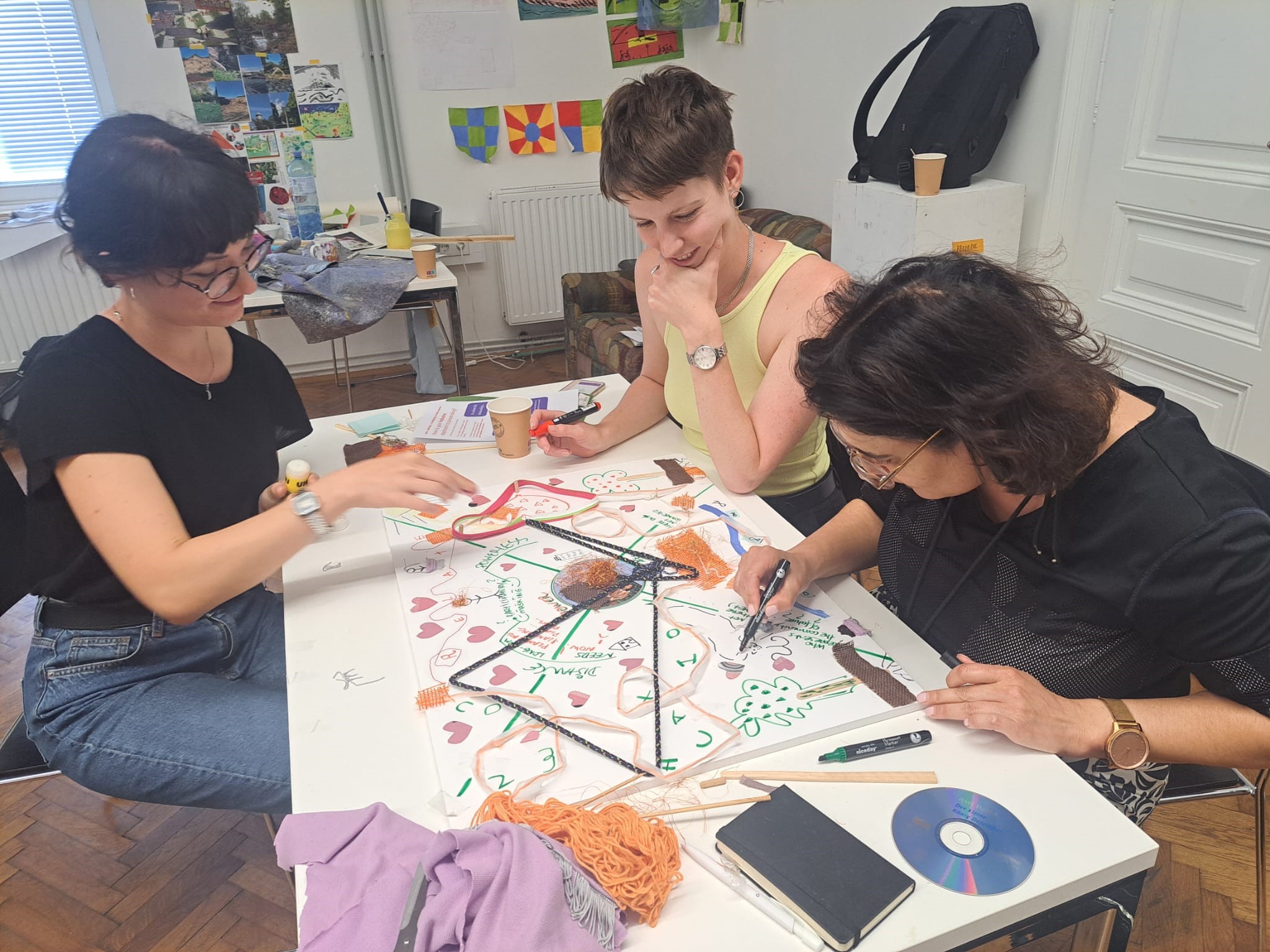
This will be facilitated through a mobile urban living lab concept, acting as a base for interventions and a temporary meeting point in itself. This mobile lab can be set up in other parts of the city too, giving more valuable insights into the issues felt surrounding inclusion in Rotterdam’s public space.
Due to BUas’ involvement in the Breda Urban Living Lab, it will also be possible to make connections with the similar site of ‘t Zoet in Breda, an area under development, within walking distance both of Breda’s train station and its city centre. So, potentially a 15-minute neighbourhood, with all kinds of services, in the making. It is hoped that the tools and methods from InclusiveCity can also be trialled and experimented in there.
International Collaborations?
International and cross-disciplinary collaborations are crucial in addressing complex and shared challenges such as inclusive urban development. By taking part in this project, BUas researchers and students are able to gather important insights in real time from fellow researchers in different national, cultural and economic contexts. The consortium is made up of members from Northern and Southern Europe and the BUas team itself is quite diverse, with members from the Netherlands, UK, Portugal and Iran.
Students will play an important role in the research. The team is currently supported by graduation students from ABEL and ALE and in the future?will involve students from the ALE Urban Life & Placemaking specialisation, ABEL Urban Design course and other graduation students.??
A mobile urban living lab concept acts as a base for interventions and a temporary meeting point.
Full results are expected at the end of 2026 with the wrap-up of the project. Interim results will be disseminated through local meetings and international conferences, including the upcoming Placemaking Week Europe conference in Rotterdam in September 2024, as well as the World Leisure Conference in 2025.
Sources
- DUT Partnership (2024),
- Khavarian-Garmsir, A.R.; A. Sharifi, A. Sadeghi (2023) The 15-minute city: Urban planning and design efforts toward creating sustainable neighborhoods, Cities, Volume132, ISSN 0264-2751.
- InclusiveCity Project Proposal (2022), internal documentation of InclusiveCity partners.?
- Janpavle, I. and U.??le (2022), The Importance of Active Leisure Areas in the Context of Urban Planning, Architecture and Urban Planning 2022, Vol. 18, Issue 1, pp. 120–130.
- Moreno, Carlos; Allam, Zaheer; Chabaud, Didier; Gall, Catherine; Pratlong, Florent (2021).?"Introducing the '15-Minute City': Sustainability, Resilience and Place Identity in Future Post-Pandemic Cities".?Smart Cities.?4?(1): 93–111.?